Posts

Ancient footprints in Crete challenge theory of human evolution – but what actually made them?
Image
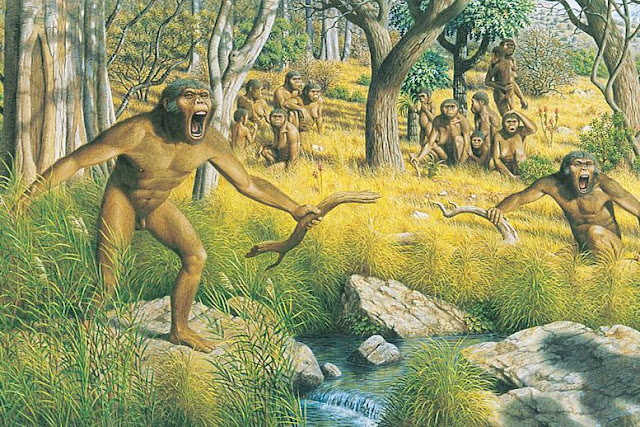
            The oldest known human footprints, from Africa, are by Australopithecus  Matheusvieeira Researchers have discovered some 50 footprints at Trachilos in Crete that are nearly six million years old. It looks like they may be from a hominin – a member of the human species after separation from the chimpanzee lineage. But, as the authors point out themselves, the findings are highly controversial – suggesting human ancestors may have existed in Crete at the same time as they evolved in Africa. So what should we make of it all? If the footprints are confirmed to be from a hominin – additional studies are needed before we can know for sure – it is unquestionably exciting. The oldest footprints confirmed as hominin are the Laetoli series, which date to 3.65 million years. The Laetoli series, found in Laetoli, Tanzania, are now known to have been made by the early human ancestor Australopithecus. It was up to six feet tall and had a foot ...

Two Moons of Uranus Might Crash Into Each Other.

Image
  A new paper predicts that two of the moons of Uranus are on a collision course with each other. Desdemona and Cressida, two small moons, are on pace for a crash in approximately a million years. The collision was predicted by a study uploaded to  arVix  by two researchers at the University of Idaho and one from Wellesley College. Uranus is the fourth-largest planetary mass in the solar system and has both a ring system and a remarkable 27 moons in orbit. The moons are divided into 13 inner moons, 5 major moons, and 9 irregular moons. Mankind's first real encounter with most of these moons was not until the 1986  Voyager 2 flyby . The researchers were studying the ring system when they noticed an odd orbit. It wasn't round or elliptical, but instead resembled a triangle. The odd shape, according to the study, is because of one of the inner moons, Cressida. Named after a title character in Shakespeare's  Troilus and Cressida,  the moon Cressida's...

Scientists have inserted a GIF of a horse into living bacteria -- did your brain just explode?

Image
In a new study published in  Nature , a group of scientists at Harvard have successfully stored a GIF— yes, like a moving meme — into live bacteria ( E. coli  to be specific). It's a weird idea, but scientists have actually been using the genetic wondertool known as CRISPR or "clustered regularly interspaced short palindromic repeats" for  data storage parlor tricks  for some time. CRISPR, explained in a bit more depth  here , makes all sorts of wild things possible and people are rightfully excited about it. Those revelations are often reserved for geneticists and health researchers, but the Harvard experiment and others like it demonstrate CRISPR's utility even beyond its vast, untapped potential in the world of medicine. As a very short primer, CRISPR-associated proteins (in this instance, specifically proteins known as Cas1 and Cas2) act as a DNA version of a computer's Ctrl-X tool, allowing scientists to pinpoint specific segments of DNA, cut th...

Indian scientists discover ‘Saraswati’, a supercluster of galaxies.

Image
Indian scientists have discovered Saraswati, a large supercluster of galaxies located in the direction of the constellation Pisces, and at a distance of 4,000 million light years away from Earth. A team of astronomers from the Inter-University Centre for Astronomy and Astrophysics (IUCAA) and Indian Institute of Science Education and Research (IISER), Pune, and members of two other Indian universities, have discovered this supercluster of galaxies.  Supercluster is a chain of galaxies and galaxy clusters, bound by gravity, often stretching to several hundred times the size of clusters of galaxies, consisting of tens of thousands of galaxies. This newly-discovered Saraswati supercluster, extends over a scale of 600 million light years and may contain the mass  equivalent of over 20 million billion suns. The discovery will be published in the latest issue of The Astrophysical Journal, the premier research journal of the American Astronomical Society....

Babies don’t discriminate until they learn how to: UBC study.

Image
Disliking people who are different is a learned behaviour, according to a new University of British Columbia study. The finding builds on previous research that showed even toddlers as young as three years old have negative associations with people different than them and prefer people of their own language, racial, and cultural groups. But UBC developmental psychology researcher Anthea Pun found one year olds in her study showed no expectations, good or bad, toward people who are different than them. “Cleary, they are not born with this bias to expect bad things from certain people,” she said. She measured 456 babies’ expectations by recording their attention spans over several repetitions of a puppet show – the longer they kept watching, the more surprised they were. Researchers found babies expected puppets that spoke their language – in this case, English – to act kind and were surprised when the puppets were mean. In contrast, babies showed no difference in atten...

China fast catching as global economic power, US at top: Survey

Image
China  is fast catching up as a global economic forum, while the public perception around the world, including India, is that the US still remains at the top, according to a new survey in 38 countries.  The survey shows "in seven of the 10  European Union  nations, China is considered the leading economic power (it is tied with the US for top spot in Italy)."  However, India continues to believe US is the world's leading economy. In fact, 41% of Indians have an unfavourable view of China, and just 26% have a more positive image of it.  India is joined by Japan, parts of Asia and  Latin America  in rooting for the Americans even as most of Russia believes China is the economic leader. Interestingly, "China leads the US by a two-to-one margin in Australia - a longtime US ally, but also a country whose top trading partner is China."  A median of 42 per cent say the US is the world's leading economy, while 32 per cent name China,...

Trillion-tonne iceberg finally snaps off West Antarctic ice shelf, scientists confirm.

Image
A TRILLION-ton iceberg which has broken free from Antarctica will do nothing to raise the world’s sea levels. But it has changed the face of the southern continent forever. “The iceberg weighs more than a trillion tonnes, but it was already floating before it calved away so has no immediate impact on sea level,” a Swansea University research team said. It will likely be named A68. The massive ice cube is twice the size of the Australian Capital Territory, four times the size of London and twice the size of Luxembourg. It is about 350 metres thick. The iceberg is more than one and a half times the size of Adelaide (3258 square kilometres), a third of the size of Brisbane (15,826 square kilometres) and more than half the size of Melbourne (9990 square kilometres). The 5800 sq km block of ice is not the largest to have ‘calved’ from Antarctica: an 11,000sq km ‘berg’ was seen to break loose from the Ross Ice Shelf in 2000. The new berg itself is destined to crumble i...